-2.gif?width=300&height=192&name=New%20Logo%20(1)-2.gif "New Logo (1)-2")
-1.png)
For many growing businesses, success creates an unexpected challenge.
More customers mean more inquiries. More projects. More follow-ups. More administrative work.
Soon, teams begin feeling overwhelmed, deadlines become harder to manage, and productivity starts to plateau. At this point, many business leaders arrive at the same conclusion:
"We need to hire more people."
But hiring is not always the first solution.
In fact, research consistently shows that operational inefficiencies often consume a significant portion of employee time. According to studies from McKinsey and Company, employees can spend nearly 20% of their workweek searching for information or tracking down colleagues for help. That is effectively one full day every week spent on activities that do not directly create value.
Before increasing payroll expenses, businesses should ask a different question:
Are we truly understaffed, or are our systems slowing us down?
The Hidden Problem Behind Growth
As businesses expand, complexity increases naturally.
Tasks that were once manageable become repetitive and time-consuming. Teams spend more time coordinating work, tracking information, responding to routine inquiries, and managing manual processes.
The result is a common feeling across growing organizations:
Everyone is busy, but progress feels slower than it should.
This often creates the illusion that more staff is the only answer.
However, adding people to inefficient systems can create new challenges. Communication becomes more complicated, management overhead increases, and operational costs rise without necessarily improving productivity.
Growth becomes expensive when inefficiency scales alongside the business.
-1.png?width=1000&height=500&name=Blog%201000%20%20500%20(1)-1.png)
Where Time Is Usually Being Lost
Many businesses are surprised when they examine how their teams spend their day.
A significant portion of time is often consumed by activities that could be streamlined or automated.
Employees may spend hours manually entering data, scheduling appointments, creating reports, tracking leads, setting reminders, searching for information, or updating multiple systems with the same details.
Individually, these tasks may seem small.
Collectively, they consume hundreds of hours over the course of a year.
The issue is not a lack of effort.
The issue is that skilled employees are spending valuable time on work that doesn't require their expertise.
The Solution Starts With Process Visibility
Before businesses can scale efficiently, they need visibility into how work actually flows through the organization.
Many operational problems remain hidden because processes evolve organically over time. Different teams create their own workarounds, information becomes scattered across platforms, and tasks are handled differently depending on who is responsible.
This creates inconsistency and slows growth.
The first step is understanding where delays occur, which processes require excessive manual effort, and where teams repeatedly encounter friction.
Once these bottlenecks become visible, opportunities for improvement become much easier to identify.
Automate Repetitive Tasks
One of the most effective ways to increase operational capacity without increasing headcount is through automation.
Many daily business activities follow predictable patterns. Lead capture, appointment scheduling, customer onboarding, invoicing, reporting, and follow-up communications can often be automated without affecting service quality.
Automation allows routine processes to happen consistently without requiring constant employee involvement.
This doesn't replace people.
It allows people to focus on work that requires decision-making, creativity, relationship-building, and problem-solving.
In many cases, businesses discover that automation creates the equivalent capacity of additional team members without the ongoing costs associated with hiring.
Centralize Information
Another common challenge is information fragmentation.
As businesses grow, customer data, project updates, invoices, communication records, and operational documents often become scattered across different tools and platforms.
Employees spend unnecessary time searching for information or requesting updates from colleagues.
This slows decision-making and creates avoidable inefficiencies.
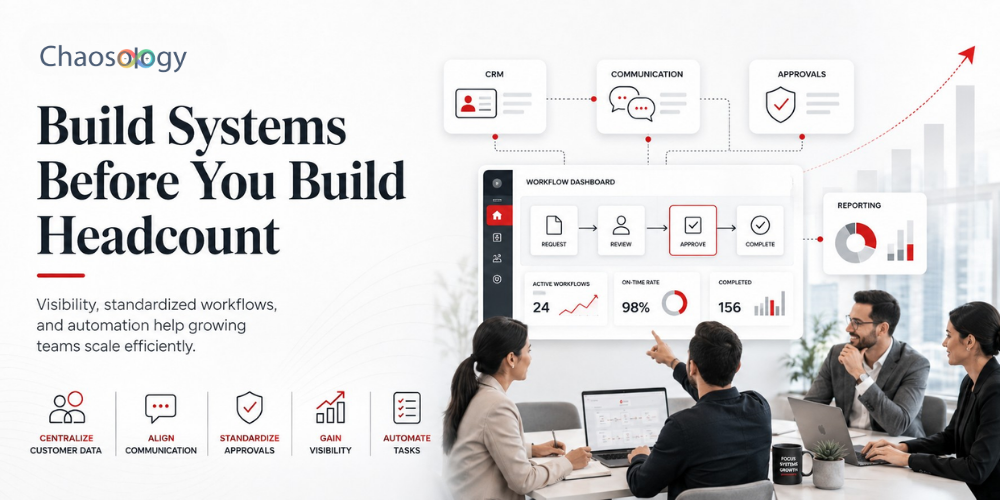
Centralized systems help teams access the information they need quickly and consistently. Whether through CRM platforms, project management tools, or integrated business systems, visibility improves dramatically when information exists in one connected environment.
The less time employees spend searching for information, the more time they can spend creating value.
Standardize Common Workflows
Many businesses rely heavily on individual knowledge rather than documented processes.
This works when teams are small. As operations expand, inconsistency becomes a significant obstacle.
Different employees may complete the same task in different ways, leading to delays, errors, and uneven customer experiences.
Standardized workflows create consistency.
When processes are clearly defined, work moves faster because employees spend less time figuring out what to do next. Training becomes easier, quality improves, and operational performance becomes more predictable.
Standardization is often one of the most simplest ways to improve efficiency without increasing staffing levels.
Improve Internal Communication
Operational inefficiencies frequently stem from communication gaps rather than workload itself.
Teams spend excessive time waiting for approvals, chasing updates, clarifying responsibilities, or tracking project status.
As businesses grow, these communication delays compound.
Clear workflows, shared systems, and automated notifications help reduce unnecessary back-and-forth communication. Teams gain visibility into project progress and responsibilities without constantly requesting updates.
This creates smoother collaboration while reducing operational friction.
Focus on Output, Not Activity
One of the biggest mistakes growing businesses make is measuring productivity based on how busy employees appear.
Activity does not always equal effectiveness.
A team can spend an entire day responding to emails, updating spreadsheets, attending meetings, and managing administrative work while making little progress toward strategic objectives.
Scaling successfully requires focusing on outcomes rather than activity.
Businesses should regularly evaluate whether processes are contributing directly to customer value and business growth. If a task exists simply because "that's how we've always done it," it may be worth rethinking.
Efficiency often comes from eliminating unnecessary work, not simply completing it faster.
Build Systems Before You Build Headcount
Hiring remains an important part of growth.
However, businesses that improve systems before expanding teams often scale more sustainably.
When operations are structured effectively, new employees become more productive faster. Processes are clearer, training is simpler, and growth becomes easier to manage.
At Chaosology, we help businesses identify operational bottlenecks, implement automation, optimize workflows, and build scalable systems that support growth without creating unnecessary complexity.
Because the goal is not simply to do more work.
The goal is to create a business capable of handling more growth efficiently.
Final Thoughts
Scaling operations does not always require hiring more staff.
In many cases, businesses already have the talent they need. What they lack are the systems necessary to support growth effectively.
Before adding headcount, it is worth examining whether manual processes, disconnected tools, communication gaps, or operational inefficiencies are limiting capacity.
The businesses that scale most effectively are often not the ones hiring the fastest.
They are the ones building systems that allow every employee to contribute at their highest value.