A customer visits your website, finds a product they like, and decides to wait before purchasing. Not because the product is too expensive, but because they know a sale might be coming. A few days later, the business announces a 20% discount, and the customer finally places the order. The promotion appears successful: a sale has been made, revenue has come in, and the customer is happy.
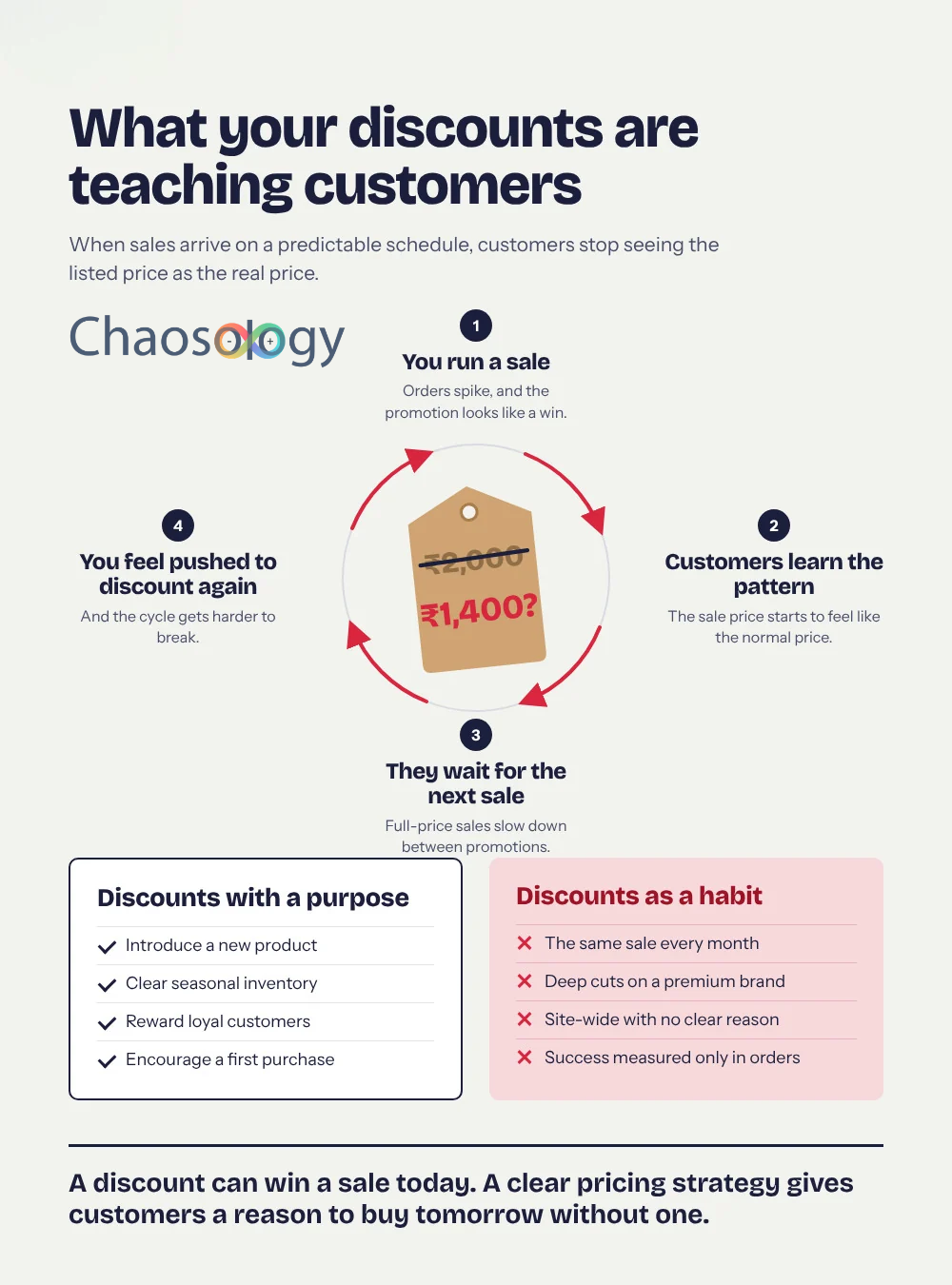
But what happens when this pattern repeats every month? Eventually, the customer may stop seeing the original price as the real price. They begin to see it as a temporary number that exists only until the next discount arrives.
For the business, this creates a difficult situation. Discounts that once encouraged purchases can gradually become the very reason customers delay them. What started as a short-term sales tactic begins shaping the brand's identity, influencing what customers expect to pay and how they perceive the value of its products.
When customers learn to associate your brand with discounts, you are no longer simply lowering prices. You are teaching them what your products are worth.
The Price Customers Remember Is Not Always the Price You Set
Pricing is often treated as a straightforward calculation involving production costs, margins, competitors, and desired profit. However, customers do not evaluate prices in isolation. They compare them with prices they have seen before, what they believe a product should cost, and what they think other people are paying.
This is where reference pricing becomes important. A customer who regularly sees a product listed at ₹2,000 but repeatedly finds it available for ₹1,400 may gradually begin to regard ₹1,400 as its normal price. The original price becomes less convincing because the customer has learned that paying the full amount is rarely necessary.
The business may still display ₹2,000 on its website, but the customer's mental calculation has changed. Instead of asking whether the product is worth ₹2,000, they begin asking when it will return to ₹1,400.
Over time, the discount becomes part of the customer's expectation rather than an unexpected opportunity. This can make full-price purchases increasingly difficult, even among customers who genuinely like the product.
The Psychology Behind Waiting for a Sale
Discounts create a powerful incentive because they offer customers the feeling of getting more value for their money. A limited-time offer can also introduce urgency, encouraging people to make a purchase they might otherwise postpone. When used thoughtfully, these promotions can help customers discover new products, encourage trial and support specific sales objectives.
The problem begins when customers become familiar with the pattern.
If a business regularly announces discounts, customers have little reason to purchase immediately. They can wait for the next sale because their previous experiences suggest that the opportunity will return. Instead of creating urgency, repeated promotions can teach customers that patience is rewarded.
Consider a fashion retailer that offers a 30% discount at the end of every month. Customers who notice this pattern may begin postponing purchases until the promotion arrives. The retailer might see a surge in monthly sales during the discount period, but some of those purchases may simply have shifted from earlier weeks rather than representing genuinely additional demand.
The business has created a cycle in which customers anticipate discounts, sales become concentrated around promotions, and the company feels compelled to offer another discount to maintain momentum.
What appears to be a successful promotional strategy can therefore become a habit that is difficult to break.
When a Lower Price Changes How Customers See Your Product
Price does more than determine what customers pay. It can also influence how they interpret the quality, positioning, and intended audience of a product.
For some categories, a higher price may signal exclusivity, craftsmanship, specialist expertise, or premium service. For others, affordability is central to the product's appeal. Neither approach is automatically better; what matters is whether the pricing strategy supports the value the brand promises.
Frequent discounts can create confusion when the brand is trying to position itself as premium. If a product is repeatedly reduced by 40%, customers may begin questioning whether the original price was realistic or whether the product was ever worth that amount.
For example, a skincare brand that consistently promotes its products at steep discounts may find that customers become reluctant to pay the listed price. Meanwhile, a competitor that communicates its value clearly and discounts less frequently may establish a stronger perception of consistency, even if its products are similarly priced.
This does not mean premium brands should never offer promotions. It means the frequency, depth, and presentation of those promotions should make sense within the brand's overall positioning.
A discount should support the value proposition, not undermine it.
The Hidden Cost of Winning Customers Through Discounts
A promotion can increase the number of transactions without necessarily improving the quality of business growth. When customers are attracted primarily by low prices, the business may find it harder to encourage repeat purchases at full price or build loyalty around qualities other than affordability.
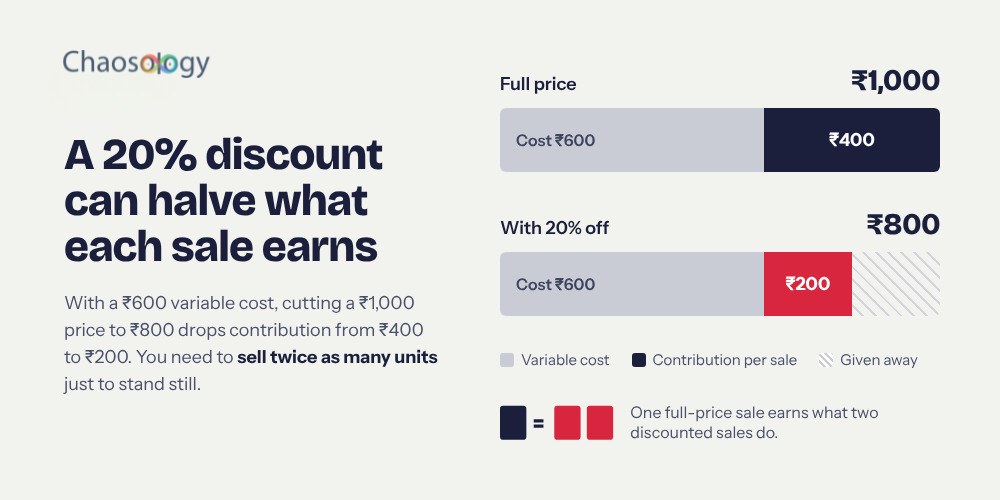
Imagine a product priced at ₹1,000 with a variable cost of ₹600 per unit. Before other expenses, the business earns ₹400 in contribution per full-price sale. If it offers a 20% discount, the selling price falls to ₹800 and the contribution falls to ₹200.
The business now needs to sell twice as many units to generate the same total contribution, assuming the variable cost remains unchanged. If the promotion does not generate enough additional sales to compensate for the lower contribution per unit, the campaign may increase sales volume while weakening the financial result.
There may also be longer-term consequences. Customers acquired through deep discounts may be less likely to return when prices rise, while existing customers who would have paid full price may simply wait for promotions. In that case, the business is not only reducing its margin on individual sales; it may also be discounting purchases that would have happened anyway.
This is why evaluating a promotion requires more than counting orders. Businesses need to examine incremental sales, contribution margins, repeat-purchase behavior and whether customers continue buying when the promotion ends.

Not Every Discount Damages Your Brand
It would be a mistake to conclude that discounts are inherently bad. They can serve legitimate commercial purposes, including introducing a new product, clearing seasonal inventory, rewarding loyal customers, encouraging a first purchase, or responding to a specific market situation.
The difference lies in whether the promotion has a clear purpose and a defined boundary.
A seasonal clearance sale communicates something different from a permanent discount that appears every few weeks. A limited offer for first-time customers serves a different objective from reducing prices across the entire product range without any clear reason. A loyalty reward can strengthen an existing relationship, while a constant public discount may train customers to delay purchases.
Businesses should therefore decide what each promotion is intended to achieve before launching it. Is the goal to attract a new audience, move excess inventory, increase basket size, or encourage customers to try a new product? The answer should influence which customers receive the offer, how long it runs, and how success is measured.
When promotions have a clear commercial purpose, they can complement a pricing strategy instead of gradually replacing it.
What Happens When You Stop Offering Discounts?
For businesses that have relied heavily on promotions, reducing discounts can feel risky. Sales may initially decline; customers may ask when the next offer is coming, and competitors may continue attracting attention with lower prices.
However, the transition can also reveal something important about the customer base: how much demand exists beyond the promotion itself.
Businesses can start by reducing unnecessary discounts gradually, maintaining consistent pricing for selected products, and strengthening the reasons customers should choose them. Clear product information, reliable service, meaningful differentiation, transparent pricing and a good post-purchase experience can all help customers evaluate value beyond the immediate savings.
It is also useful to communicate promotions differently. Instead of making every offer about a lower price, a business can provide value through bundles, complimentary services, useful product guidance, or benefits for existing customers. These approaches should still be evaluated carefully for their cost and effectiveness, but they can create reasons to buy that do not depend entirely on reducing the listed price.
The goal is not to convince customers that price does not matter. Price always matters to some extent. The goal is to ensure that price is not the only reason they choose the business.
Building a Brand That Customers Are Willing to Pay For
Strong pricing strategies begin with a clear understanding of the value a business delivers and the customers it intends to serve. Some customers will always prioritize the lowest available price, while others may be willing to pay more for quality, convenience, reliability, design, service or a particular experience.
Businesses need to understand which of these motivations matter most to their target audience and build their positioning accordingly. If affordability is the core promise, competitive pricing may be an important advantage. If the brand is built around expertise or premium quality, constant discounting may send a conflicting message.
Consistency is central to this relationship. Customers should be able to understand why a product costs what it does and what they receive in return. When prices fluctuate without a clear reason, it becomes harder for them to develop a stable perception of value.
This does not require a business to charge the highest price or avoid every promotion. It requires the business to make pricing decisions deliberately, with a clear connection between the price, the product, and the promise being made to customers.
The Real Question Is What Your Discounts Are Teaching Customers
Every promotion communicates something, whether the business intends it or not. A carefully timed offer may encourage a first purchase, reward loyalty or help move seasonal inventory. Repeated, predictable discounts may instead teach customers that the listed price is negotiable and that waiting is the smartest way to shop.
Over time, these expectations can influence purchasing decisions, brand perception, and profitability. The challenge is not simply to decide how much to discount, but to understand the behavior that discounting encourages and whether that behavior supports the business's long-term goals.
Before announcing the next sale, businesses should ask themselves what they want customers to remember afterwards. Is it that the product delivers exceptional value, that the brand understands their needs, or that the best time to buy is always later?
A discount can persuade someone to purchase today, but a well-designed pricing strategy gives them a reason to buy tomorrow without needing another one.